Quick summary
- A temperate riverside city: changeable spring days, warm summers, soft golden autumn light and grey, damp winters. Layers work better than one heavy coat.
- Showers move through quickly off the Rhine. A light waterproof shell and grippy shoes matter more than an umbrella on the exposed quays.
- The gaps between the harbour blocks act like funnels, so a calm street can turn breezy at the water. A scarf and a hood help in the colder half of the year.
- The MedienHafen Tour runs 2 hours and can be cancelled free of charge up to 24 hours in advance.[1]
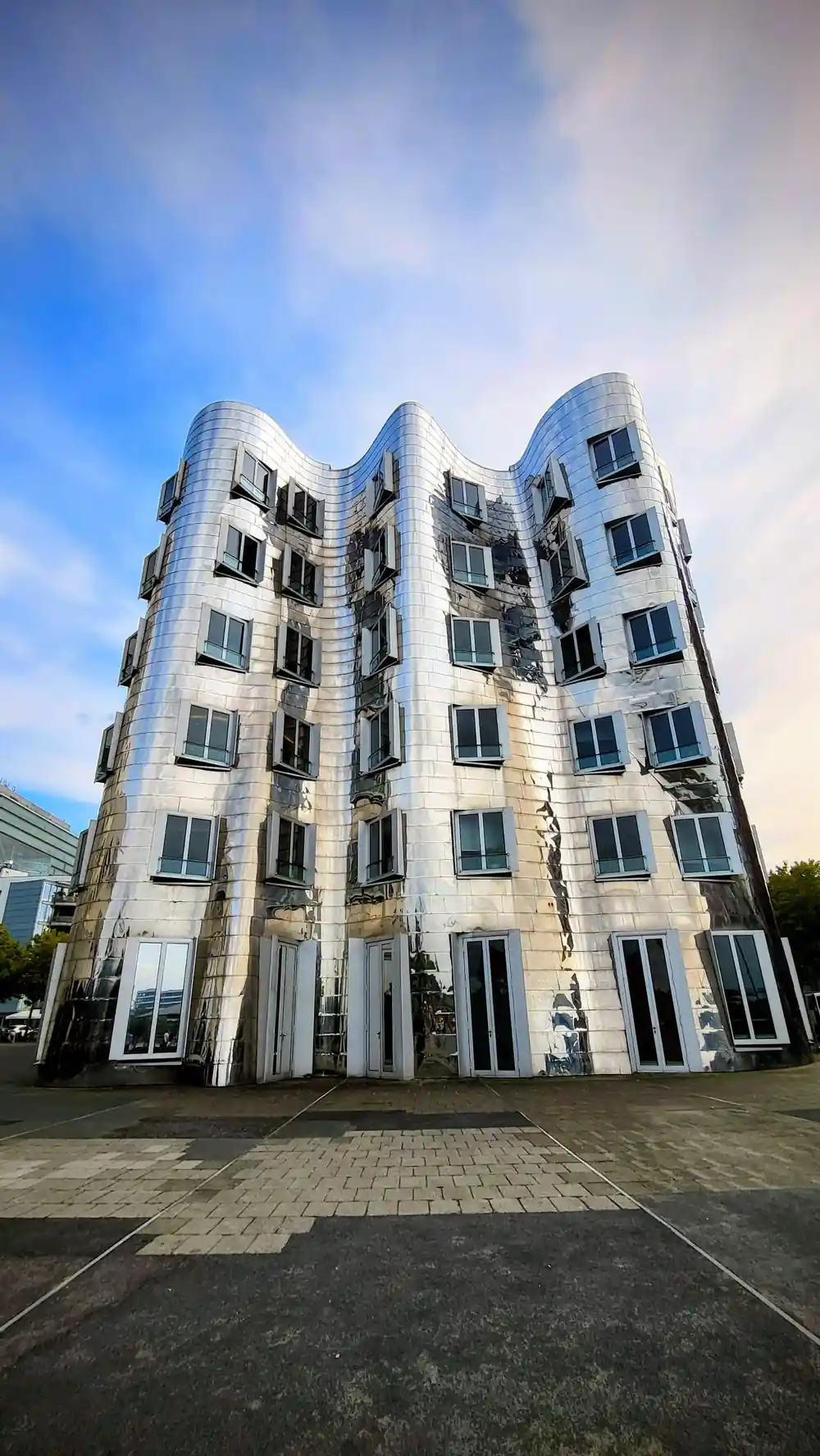
- Low sun and long shadows bring out the curves of the Neuer Zollhof, completed in 1999, and the coloured glass of the newer blocks.[2]
- Top choice MedienHafen Tour from US$218 Duration2 hours[1]Guide languagesGerman, English[1]Rating4.64 from 276 reviews[1]CancellationFree cancellation up to 24 hours[1] Check availability
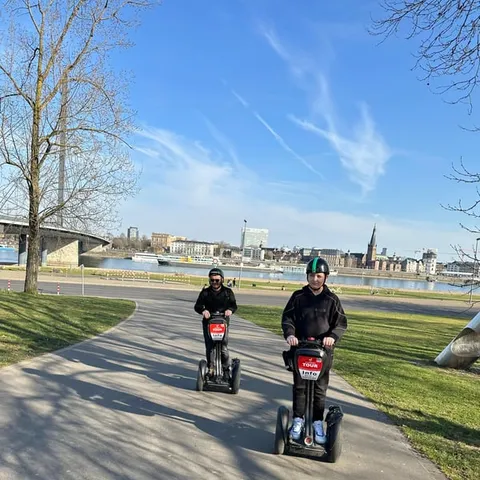
- Segway Tour along the Rhine from US$91 Duration2 hours[3]Guide languagesGerman, English[3]Rating4.90 from 189 reviews[3]CancellationFree cancellation up to 24 hours[3] See this tour
- Altstadt Old Town Tour from US$218 Duration1.5 - 2 hours[4]Guide languagesGerman, English[4]Rating4.50 from 488 reviews[4]CancellationFree cancellation up to 24 hours[4] See this tour
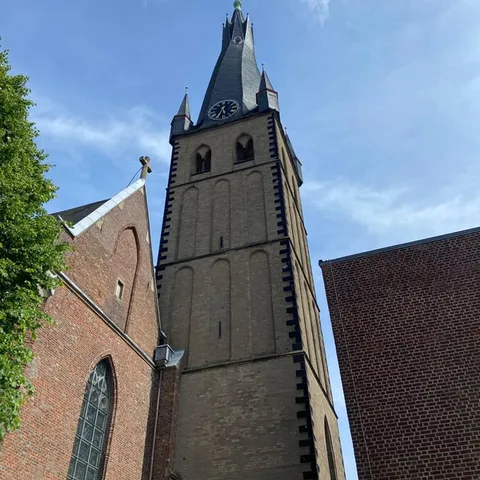
In 1995, the Rhine crested at 10.69 meters at Dusseldorf, testing the harbor's flood defenses.
Is the MedienHafen walk worth it in any weather?
Pack for the day
- Sunglasses and a cap, the quays have little shade at midday
- A packable waterproof jacket rather than an umbrella
- A thin scarf or buff for wind funnelling between the buildings
- Shoes with grip, wet stone and cobbles get slippery
Düsseldorf Germany Weather, Season by Season
Düsseldorf sits low on the Rhine, on open ground with no hills to slow the Atlantic air that arrives from the west. That is why a day here changes its mind so easily. A grey morning can turn bright by midday and wet again before dinner. Locals dress in layers and keep a thin waterproof jacket within reach all year round, not just in winter. For a harbour walk the useful habit is simple: read the forecast on the morning of your booking, then plan the walk around the driest window rather than around the calendar.
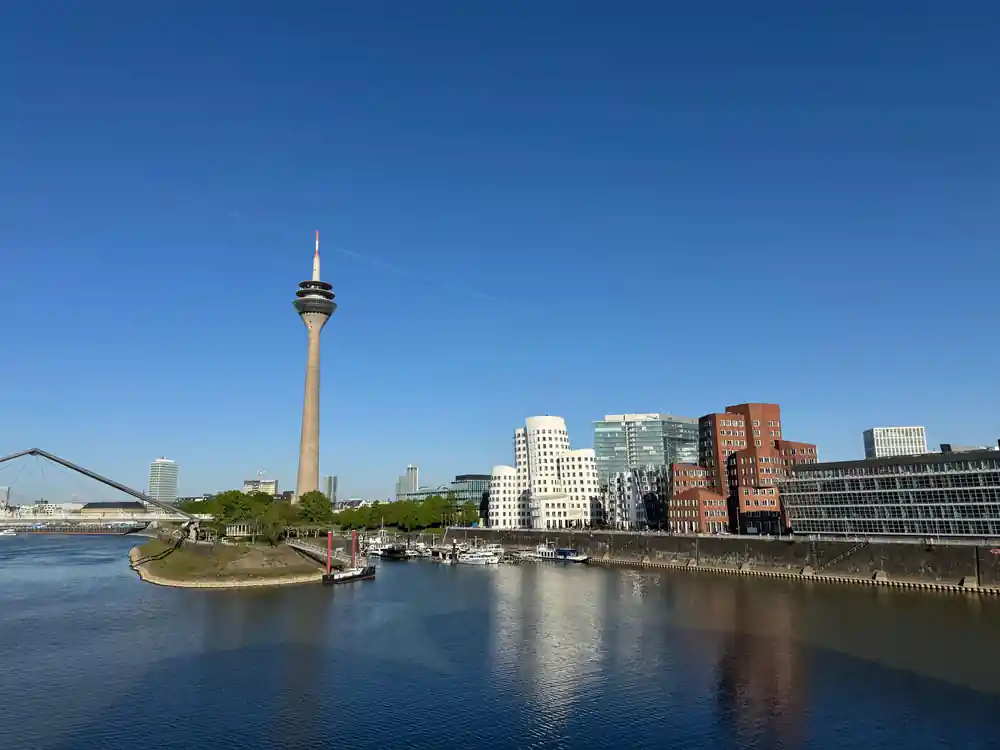
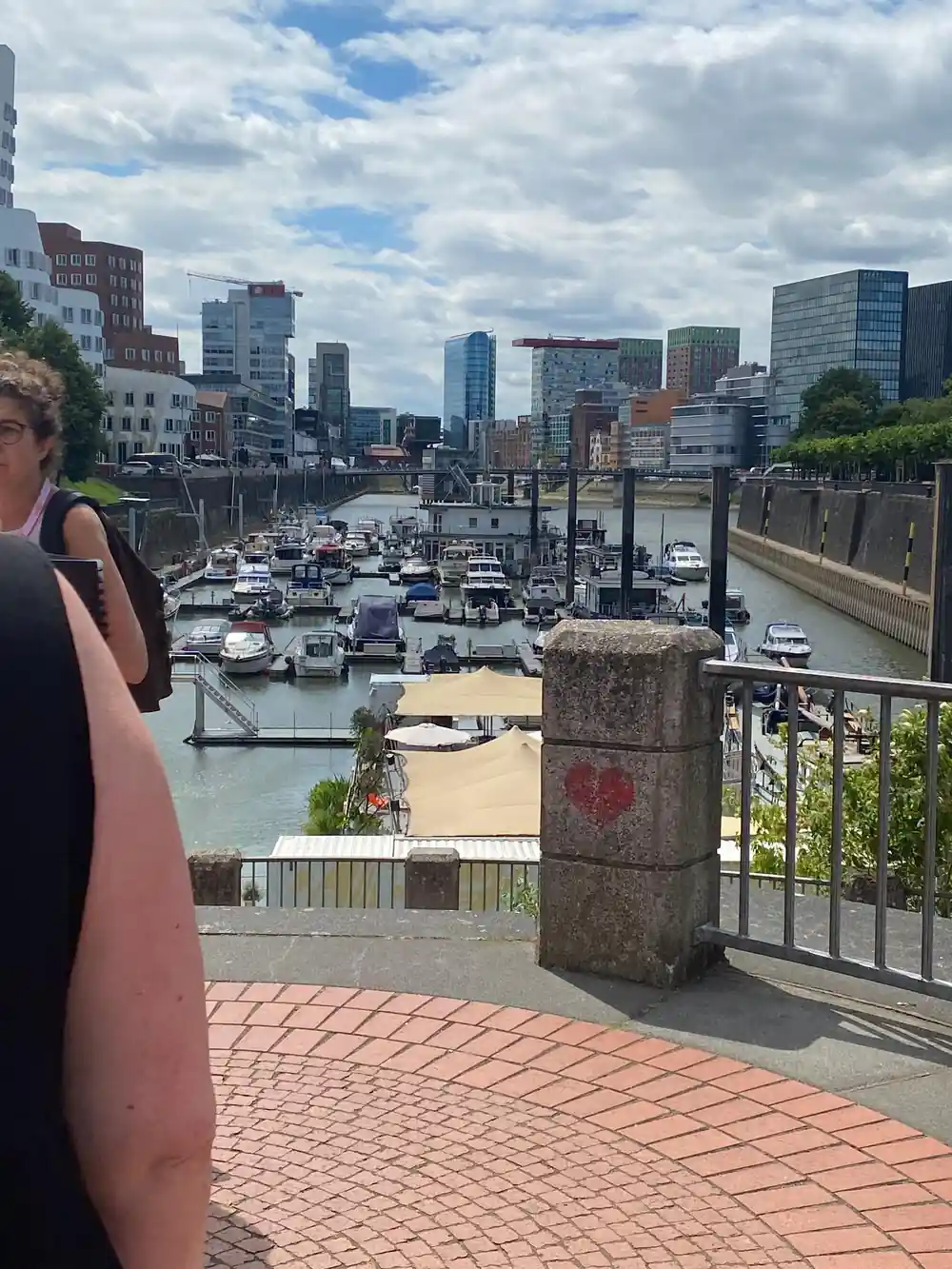
The river shapes everything about the district. The Rhine runs 1320 km, and its wide bend at Düsseldorf gives the MedienHafen its water, its reflections and its breeze.[5] The harbour you walk through was a busy working port at the end of the 19th century, and it played a part in the city's boom until the end of WWII.[6] Today more than 700 companies have addresses in the district, from media offices to restaurants along the water.[7]
That mix of open water and dense building is why the weather here feels different from the sheltered streets a few minutes inland. Wind finds the gaps, rain arrives sideways on the exposed quays, and sunlight bounces off glass and water at the same time. Knowing that in advance is most of the battle when you are deciding what to pack.
Rain, Storms and the Walk Along the Quays
Rain in Düsseldorf usually arrives as showers rather than as a solid day of drizzle. They come in off the river, cross the quays and move on, which suits a walk of 2 hours that keeps moving.[1] The catch is shelter. The harbour is open ground, umbrellas turn inside out in a gust on the exposed stretches, and a hooded waterproof shell leaves both hands free for a camera or a phone.
Flood water is part of the district's story. In 1995 the Rhine crested at 10.69 meters at Dusseldorf, testing the harbor's flood defenses.[8] You can see the river's reach in the raised edges, steps and mooring points along the water, and in the way the newer buildings sit back from the main channel. Heavy weather rarely lasts long here, but when it does arrive it arrives with a wind behind it.
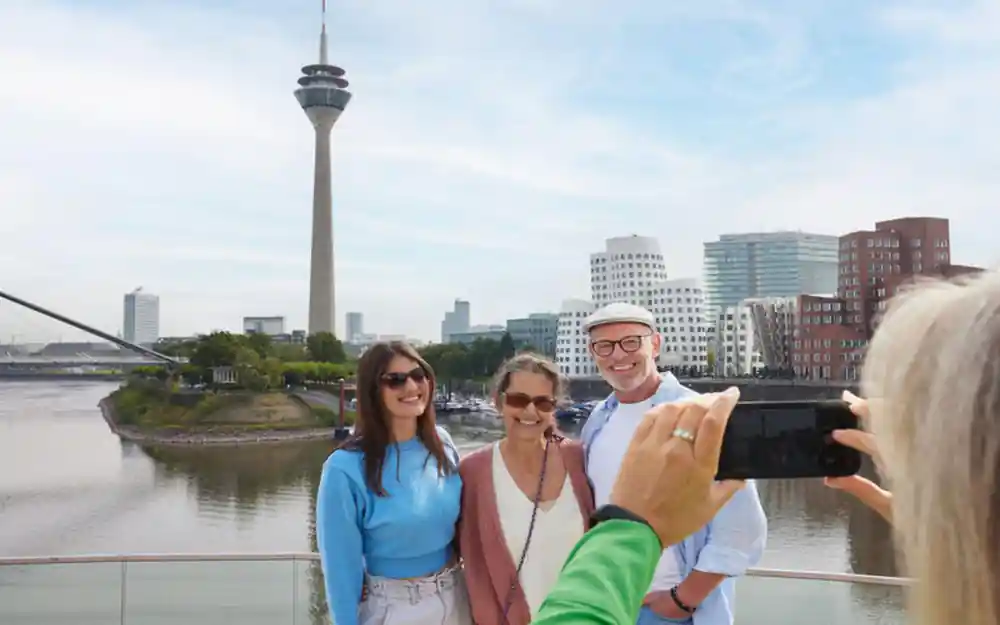
Wet paving and glass on the harbour quays after a passing shower.
Summer Heat and Where to Find Shade
Summer is the season for evenings in the MedienHafen. The light lasts late, the restaurants spill onto the quays, and the water keeps the air moving even when the city centre feels still. The middle of a bright afternoon is the harder time to walk, because the harbour gives away very little shade: glass, pale concrete and open paving throw the light straight back at you. If you feel the heat, book an early or a late slot and carry water.
Shade exists if you know where to look. Arcades and recessed entrances around the office blocks give a few metres of relief, the rows of trees along the promenade help, and the riverside cafes are set up for sitting out a hot spell. Look up for the Rheinturm, 240.5 metres tall and built between 1979 and 1982, which gives you a fixed point to navigate by.[9] Its light clock, the Lichtzeitpegel, is an installation by Horst H. Baumann that reads out the time in a vertical series of lights.[10]
A hat makes more difference than an extra layer on a hot day, and a light long-sleeved shirt protects your shoulders during a long walk in the sun. Evenings are usually the kindest hours, and they are also when the reflections on the water are at their most colourful.
Wind Funnelling Between the Harbour Buildings
Wind is the part of Düsseldorf weather that surprises visitors most. The streets behind the harbour can feel calm, then a few steps further on, between two blocks and out at the water's edge, the air is suddenly moving. The quay is a long open shelf beside a river, and the gaps between the buildings act like funnels. Hold on to hats, scarves and loose camera straps, and expect a breeze even on a mild day.
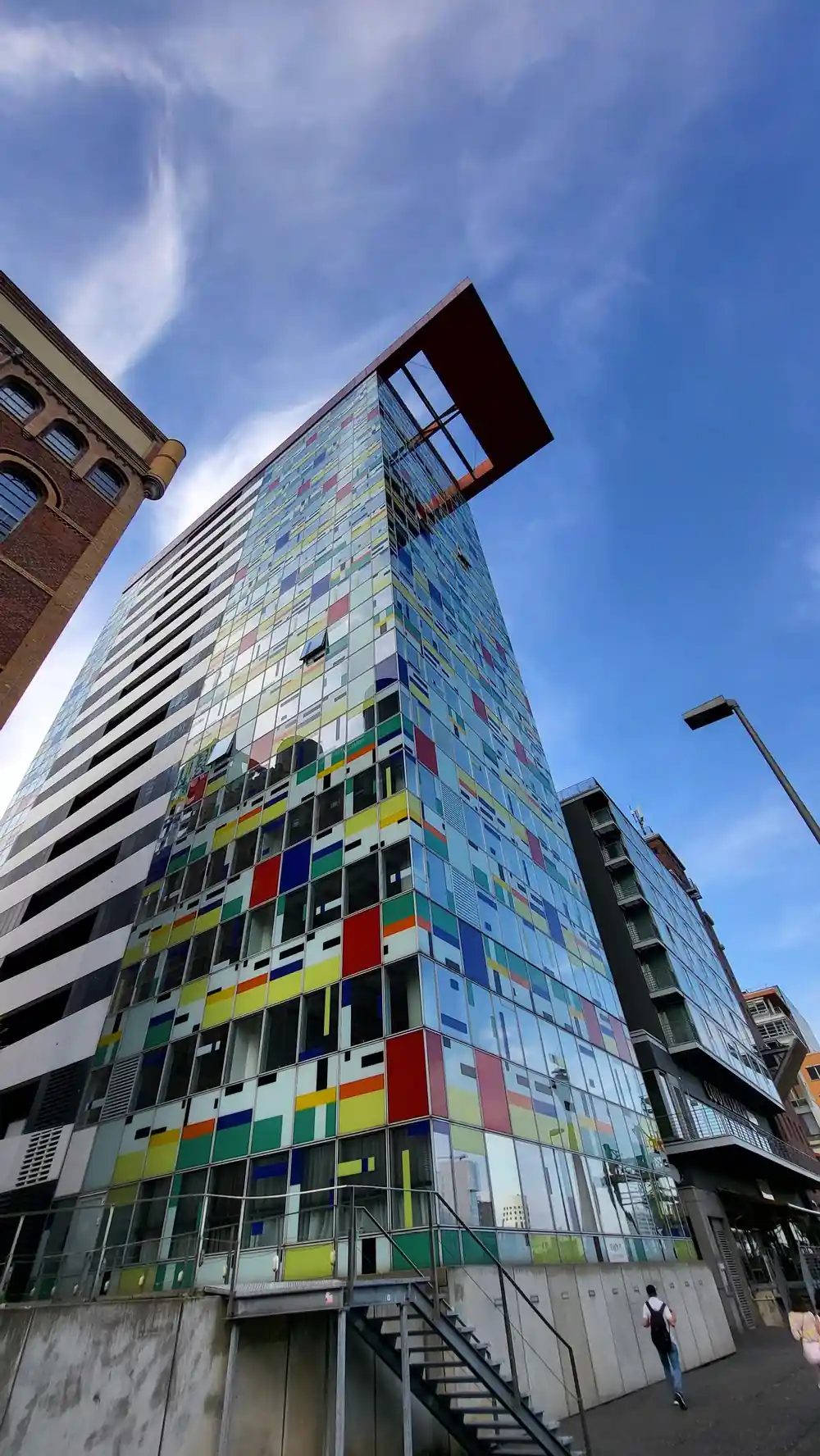
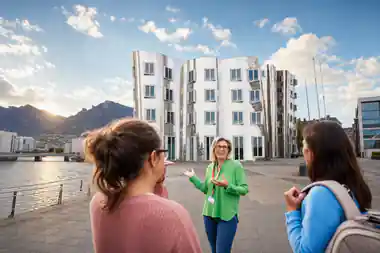
The architecture makes the effect more interesting to watch. The Neuer Zollhof, a complex of three buildings designed by Frank Gehry, was completed in 1999, and its leaning, curved walls turn the streets around it into odd little canyons.[2] Further along, the Colorium Building, designed by Will Alsop, stands 17 stories tall behind printed glass that shifts colour as the cloud and light change.[11] On a windy day the reflections move faster than the buildings do.
from US$218
The MedienHafen Tour, booked from this site, takes 2 hours with a live guide, from US$218.[1]
Winter on a MedienHafen Walking Tour
Düsseldorf in winter is grey, damp and often windy, with short days and a low sun that sits close to the horizon when it appears at all. The MedienHafen Tour takes 2 hours and runs with a live guide in German and English.[1] Expect to be outdoors for most of that time, on the quays and between the buildings, where the river air makes everything feel colder than a forecast might suggest.
Plan for it: a warm base layer, a windproof outer layer, gloves and shoes that cope with wet paving. Book with free cancellation, which for this tour means you can cancel up to 24 hours in advance for a full refund if the weather turns.[1] You can also reserve now and pay later.[1] A private group is available if you would rather walk with your own party.[1]
Light arrives late and leaves early in winter, so an afternoon slot often ends with the buildings lit up against a dark sky and the water reflecting the office windows. Finish with a warm drink in one of the harbour restaurants and the cold stops mattering quite so much.
Light and Colour Through the Year
Photographers tend to favour the shoulder seasons, when the sun stays low and the light comes in at an angle. Spring and autumn give long shadows across the quays and pick out the curves of the Gehry buildings and the coloured panels of the newer blocks. Midsummer brings very long evenings and a hard, bright light in the middle of the day. Midwinter brings the blue hour early, when office lights come on behind the glass and the water turns dark.
The city is a popular destination and it shows in the busy periods. Düsseldorf recorded 3,068,803 guest arrivals in 2018.[12] The vacant working harbour was reimagined as the MedienHafen media district during the 1980s and 1990s, and the result is a place that photographs well from almost any angle.[13]
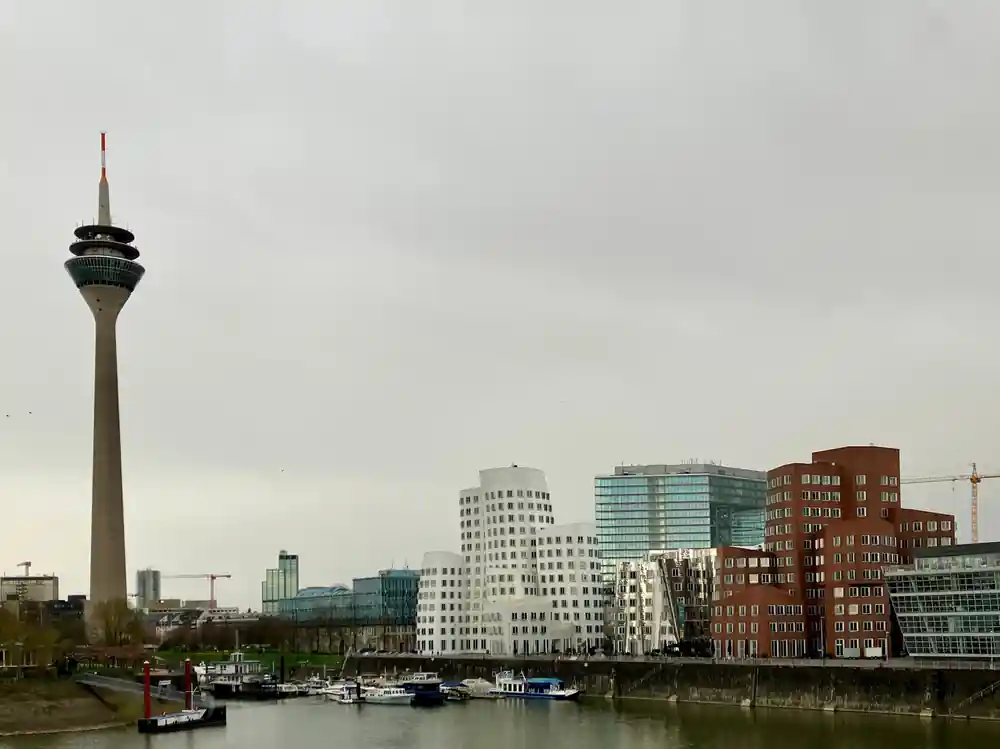
Grey days are not wasted either. Flat light softens the contrast between the glass facades and the sky, and the buildings look cooler and more sculptural than they do in sunshine. If you want a quiet stretch of quay, go early, when the promenade belongs to runners and dog walkers rather than tour groups.
Sundays, Holidays and the Christmas Season
The MedienHafen is a working district, so weekdays have a rhythm of office workers at lunch and quiet stretches in between. Weekends and public holidays are calmer in the business streets and busier along the water and in the old town. Starting times for the walk vary by date, so check availability when you book.[1] The tour runs in German and English with a live guide.[1]
In the Christmas season the harbour is at its most atmospheric in the evening, when the office windows glow and the water reflects the lights. The old town markets draw the crowds, while the quays stay relatively open, and a walk of 2 hours fits neatly between an afternoon in the city and dinner.[1] Winter clothing matters more than ever, and a warm drink afterwards is part of the routine.
From prices for Düsseldorf tours
Compare tour prices for a harbour day
From-prices in US dollars from these listings, with no separate child price shown:[1][3][4][14]
When to book the MedienHafen walk
Plan around the weather
Check the forecast
Look at the morning forecast before you set out and keep half an eye on the showers moving in off the Rhine.
Dress in layers
A thin base layer, a warm mid layer and a waterproof shell cover most days in Düsseldorf, whatever the season.
Wear the right shoes
Paving and cobbles around the harbour stay slick after rain, so choose shoes with grip rather than smooth soles.
Book a flexible slot
Reserve now and pay later, and note that free cancellation up to 24 hours in advance applies to the MedienHafen Tour.[1]
Book the MedienHafen walk and keep an eye on the sky
from US$219Reserve now & pay later