Quick summary
- MedienHafen translates as media harbour: Medien for media, Hafen for harbour, a working port turned into a district of offices and studios.
- At the end of the 19th century the docks lay at the southern end of the Rheinuferpromenade and shared in the city's boom until the end of WWII.[1]
- City planners and developers reimagined the vacant waterfront in the 1980s and 1990s, and the old basins stayed at the centre of the new district.[2]
- The Neuer Zollhof complex of three Gehry buildings was completed in 1999, and the Colorium Building by Will Alsop stands 17 stories tall.[3][4]
- The MedienHafen Tour lasts 2 hours with a live guide in German and English, and it is rated 4.64 from 276 reviews.[5]
- Top choice MedienHafen Tour from US$218 Duration2 hours[5]Rating4.64 from 276 reviews[5]GuideGerman and English[5]CancellationFree, up to 24 hours[5] Check availability
- City Architecture Walk from US$23 Duration2 hours[6]Rating4.74 from 65 reviews[6]GuideGerman[6]CancellationFree, up to 24 hours[6] See this tour
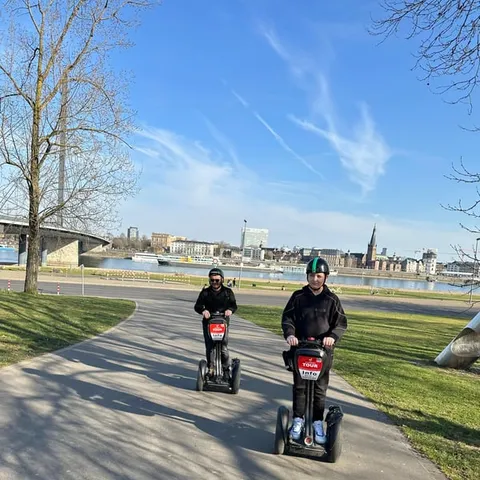
- 2-Hour Segway Tour from US$91 Duration2 hours[7]Rating4.90 from 189 reviews[7]GuideGerman and English[7]CancellationFree, up to 24 hours[7] See this tour
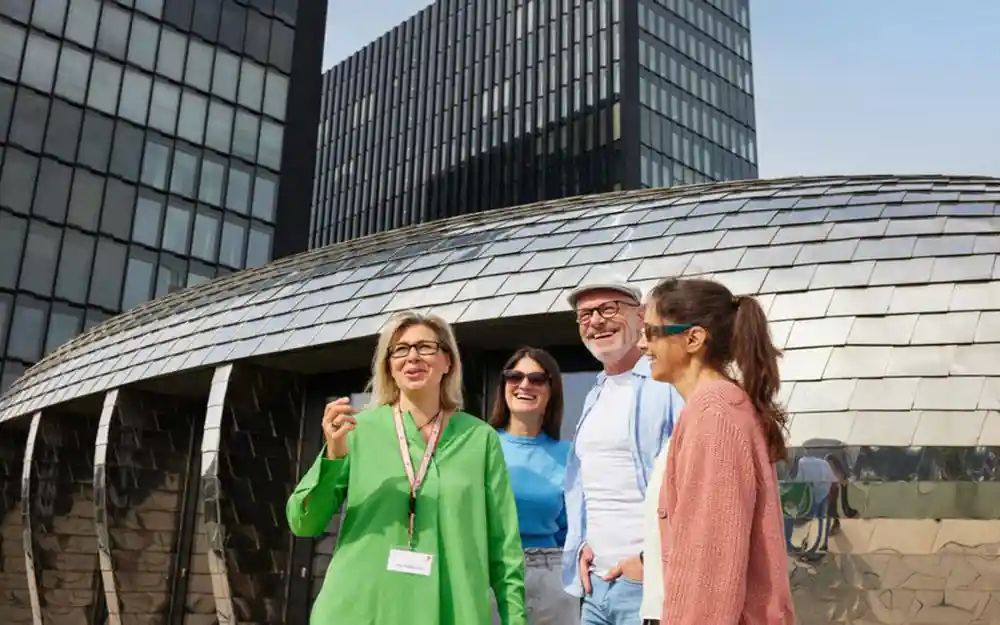
In the 1980s and 1990s, Dusseldorf's city planners and developers recognised an opportunity in the vacant waterfront.
Is the MedienHafen worth your time?
Getting there and around
- Trams and buses stop near the riverside, and the old town is a short walk away.
- Paths along the water are flat and mostly step-free, which suits wheelchairs and pushchairs.
- The district is compact; add time if you plan to eat by the basin or go up the Rhine Tower.
- Morning light falls on the facades and late afternoon is best for the water side of the basin.
Practical tips
- Tour listings show from prices in US dollars, so check the current rate before you book.
- The wind off the water is brisk, so carry a light jacket even on a mild day.
- Book the MedienHafen Tour ahead, with free cancellation up to 24 hours in advance.[5]
- A private group is available on the MedienHafen Tour and on the Altstadt Guided Tour.[5][8]
A Working Harbour: The Cargo Years
The name answers the question before you arrive. MedienHafen means media harbour: Medien for media, Hafen for harbour. Ask Medienhafen was ist das in German and you will get the same reply, that this is Düsseldorf's old river port on the same water it always used, with freight sheds and warehouses now holding offices, studios and restaurants. At the end of the 19th century, the city's docks lay at the southern end of the Rheinuferpromenade.[1]
Cargo arrived by barge. The Rhine is 1320 km long,[9] and its broad water was the working surface of the port. Coal, grain, timber and iron came out of the holds and went into sheds and onto carts. Forwarding agents handled the paperwork, and the street name Speditionstraße still points at their trade, since a Spedition is a forwarding business, the people who move other people's goods. In the MedienHafen Düsseldorf, Speditionstraße remains the spine of the district and a sensible place to start a walk.
For decades the quays worked the way ports do: early starts, cranes swinging, barges queued along the wall, shouts carrying over the water. The docks played a part in the city's boom until the end of WWII,[1] and the river never stopped being a neighbour to be respected. In 1995, the Rhine crested at 10.69 meters at Dusseldorf, testing the harbour's flood defences.[10]
Decline and the End of Commercial Shipping
Then the working waterfront emptied. Cranes stopped swinging, barges stopped queuing, and the sheds stood open to the weather. The land and the water stayed where they were, close to the old town and to the Rhine embankment promenade, which runs for one and a half kilometers.[11] For a while the district was a large, quiet piece of riverbank with good bones: basins, quay walls, rail lines, brick. Nothing about the layout needed inventing, only a reason for people to come.
Flood water stayed part of the picture. In 1995, the Rhine crested at 10.69 meters at Dusseldorf, testing the harbour's flood defences.[10] Anyone building or walking here has to share the place with a river that rises, and the quay walls, steps and promenade all sit within reach of it.
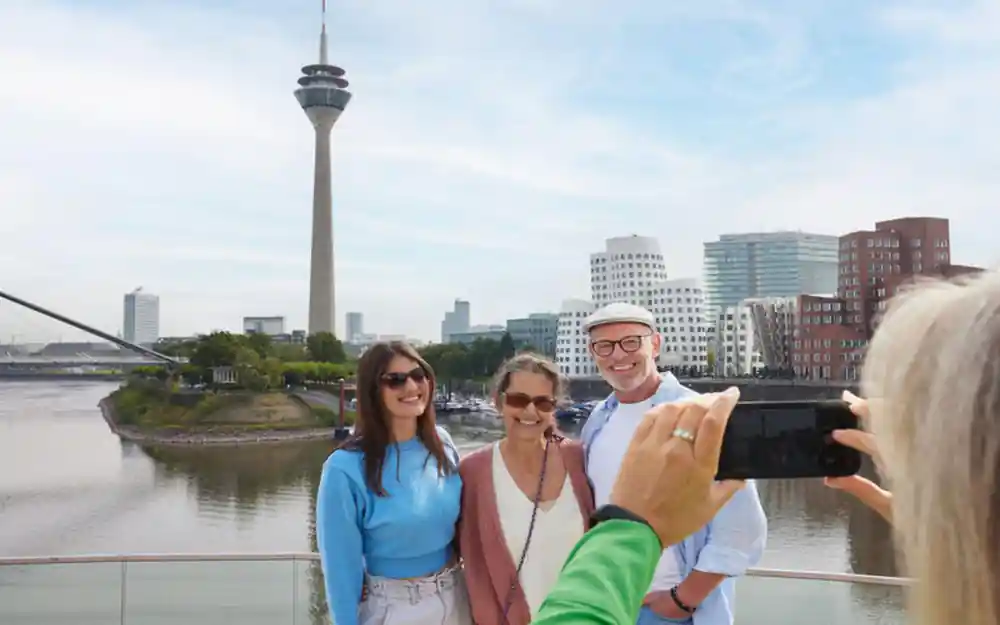
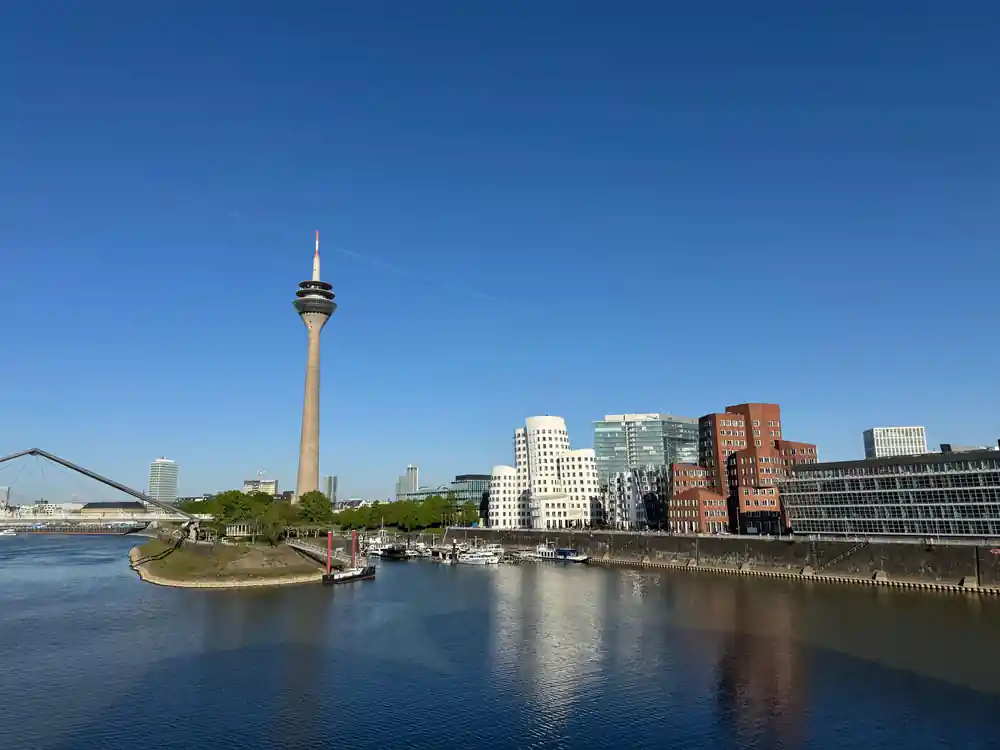
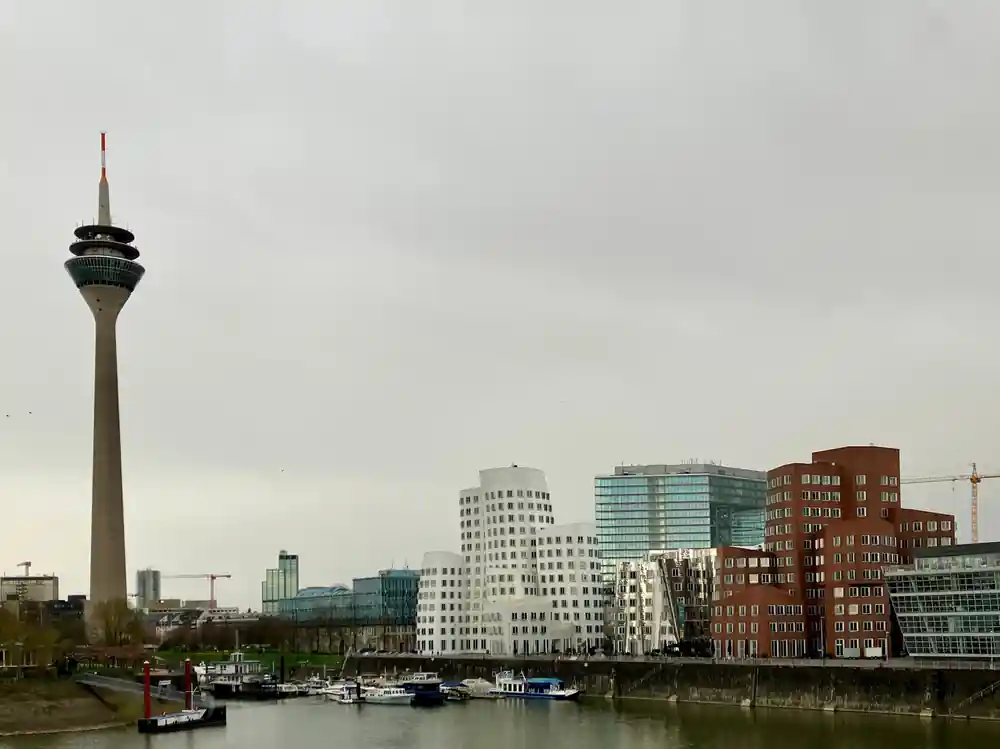
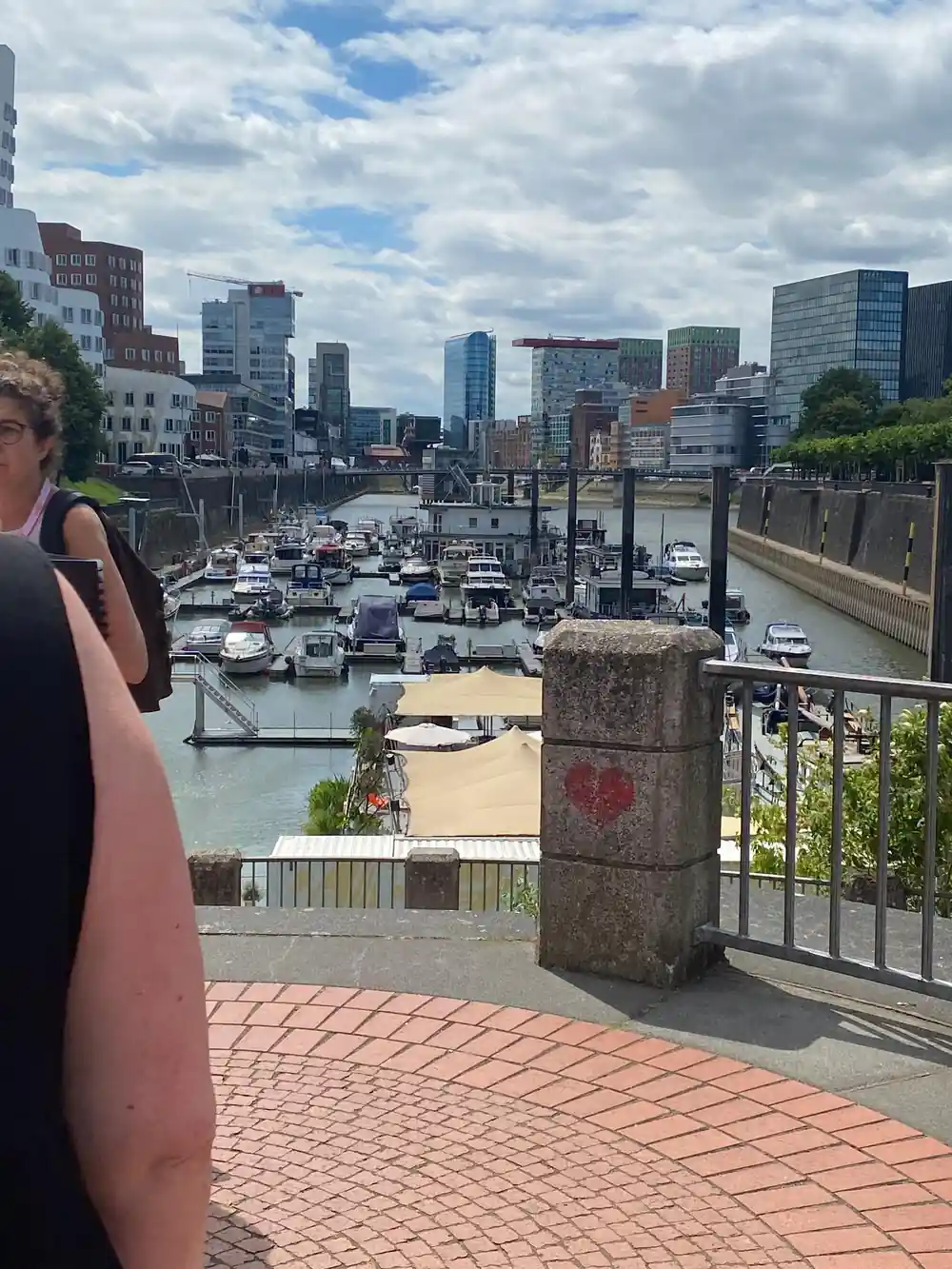
Curved facades and a still basin: the MedienHafen keeps water at the centre of the district.
Reimagining the District: The MedienHafen Concept
The plan kept the water in the middle. During the 1980s and 1990s, Dusseldorf's city planners and developers reimagined the vacant former working harbour as the MedienHafen media district.[2] The old basins became the centrepiece, with quays, footbridges and pontoons around them, and buildings on both sides looking at each other across the harbour. The result reads as a harbour first and a business district second.
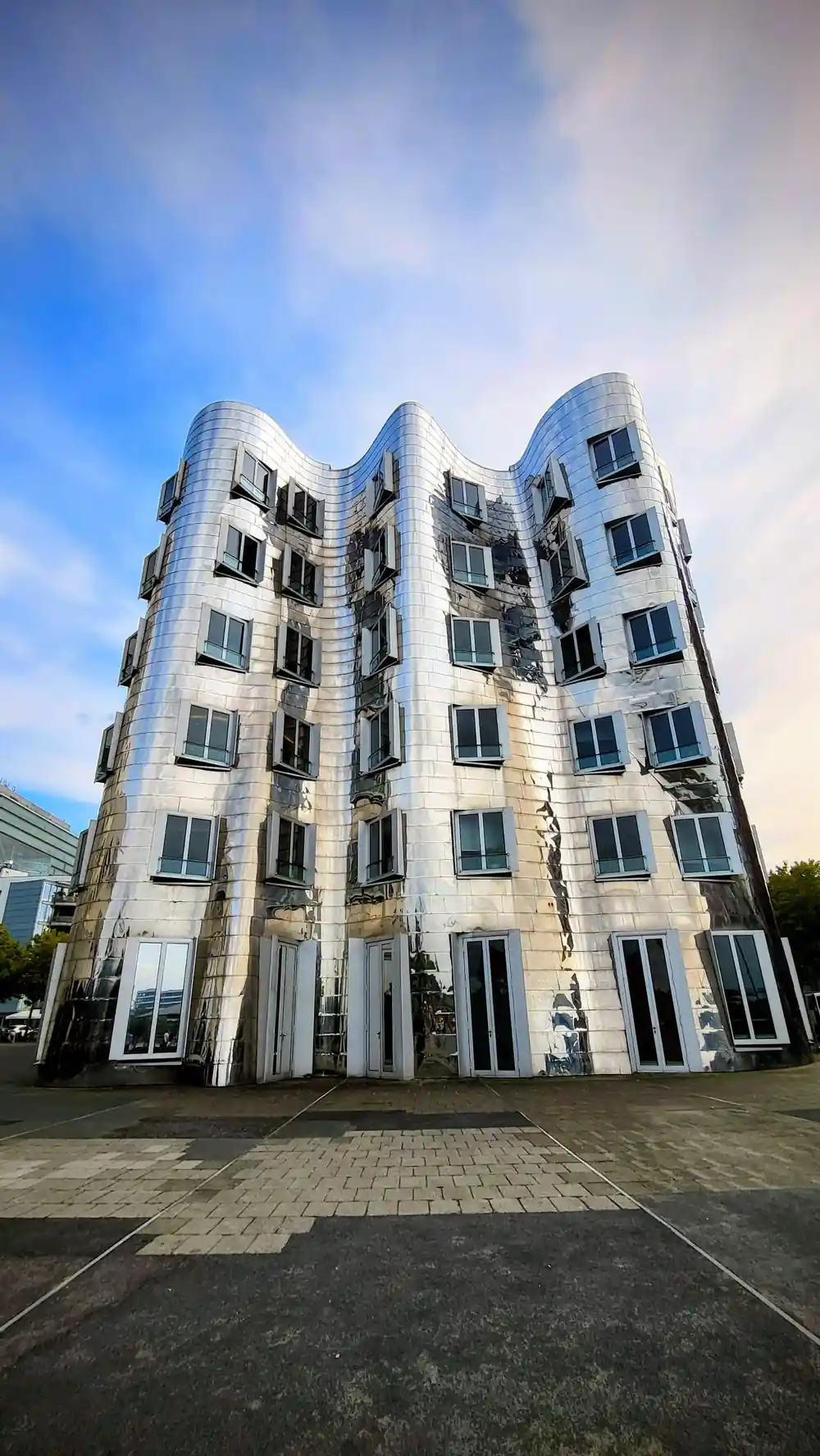
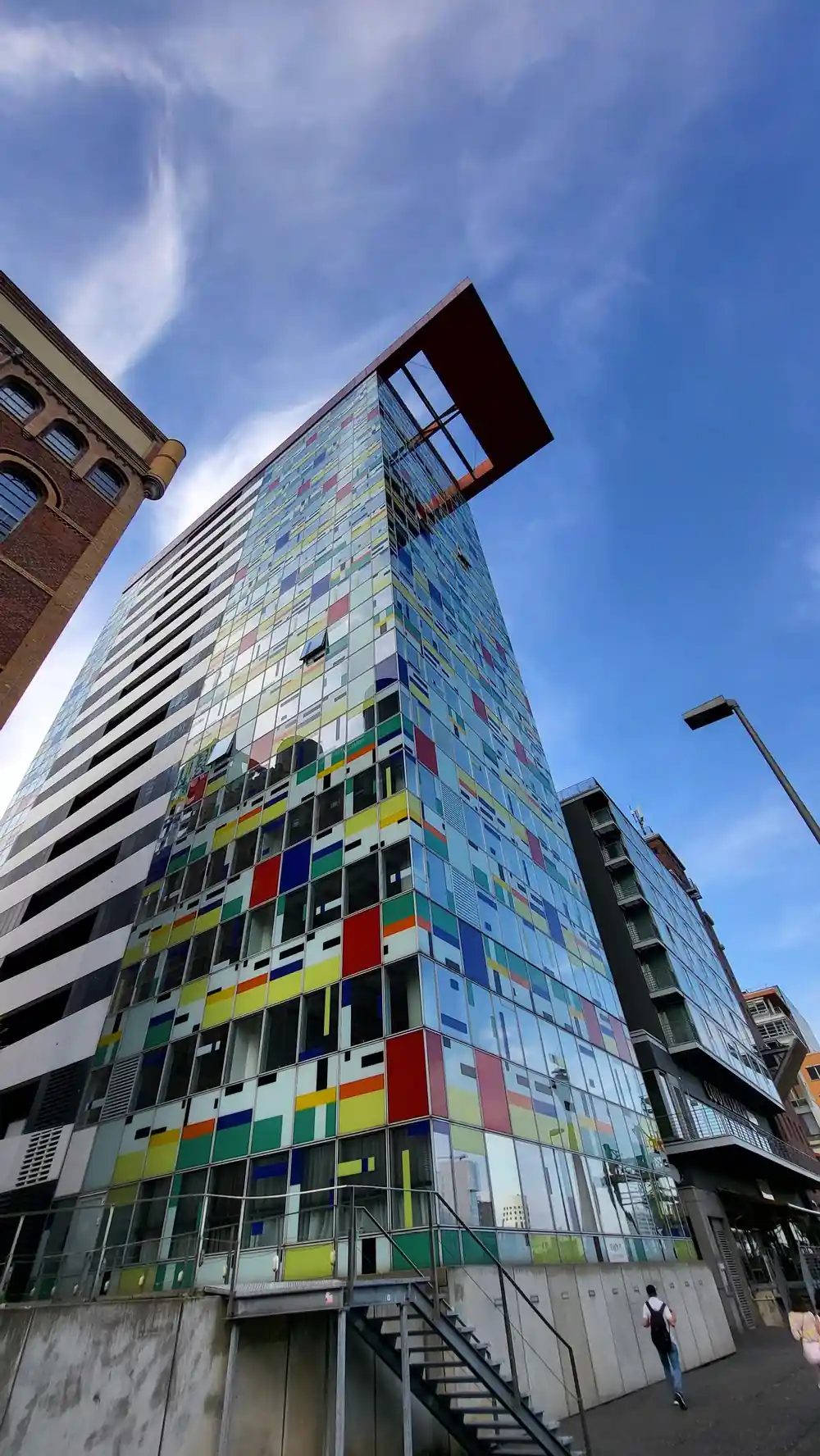
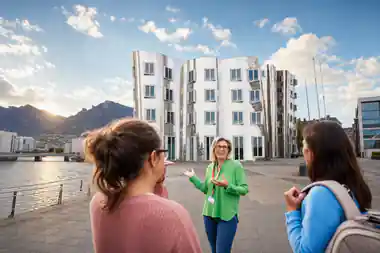
Architecture did much of the talking. The Neuer Zollhof is a complex of three buildings designed by Frank Gehry that was completed in 1999,[3] and each one is finished differently, so the group looks like three relatives rather than triplets. Walk around the back and the leaning walls make the surrounding towers seem to tilt. The Colorium Building, designed by the British architect Will Alsop, stands 17 stories tall,[4] and its glass panels shift colour as the light moves.
The Rhine Tower guards the district's southern edge. The Rheinturm is 240.5 metres tall and was built between 1979 and 1982.[12] Its light clock, the Lichtzeitpegel, is an architectural installation by Horst H. Baumann that shows the current time as a vertical series of lights in a simplified decimal reading layout.[13] You can enjoy it without decoding it, and after dark it becomes the clearest landmark on the waterfront.
The Arrival of Media and Advertising: New Life
The district grew into its name. More than 700 companies are based in the MedienHafen, and the district also counts some of the city's best and most popular restaurants among its addresses.[14] Media, advertising, design and technology firms took the new floor space, and older sheds found tenants who liked high ceilings, brick walls and a view of the water.
Düsseldorf pulls visitors far beyond the harbour walls. The city recorded 3,068,803 guest arrivals in 2018.[15] Weekday lunchtime brings office workers to the quay-side tables, and in the evening the crowd drifts between the bars that open onto the water. Weekends are busiest along the promenade, when the basins fill with the reflections people came to photograph.
The mix is what makes the district work as a place to spend an afternoon rather than simply look at. Offices, apartments, studios, restaurants and public quays share the same water, and the whole area is small enough to cross on foot in either direction.
over 700
companies are based in the MedienHafen, along with some of the city's best and most popular restaurants.[14]
Structures That Survived: Cranes, Rails and Warehouses
Plenty of the working port survives in the details. Rails still sit in the paving, iron mooring rings are set into the quay walls, and the brick and rendered facades of the old warehouses stand inside or beside newer glass shells. Cranes have been kept as monuments rather than sent for scrap, and the basin still holds water, which is what makes the place feel like a harbour rather than an office park.
Sizes help you read the transformation. The Rhine embankment promenade runs for one and a half kilometers,[11] the Rhine is 1320 km long,[9] and the tower that overlooks the district is 240.5 metres tall.[12] Standing on the quay you can hold all three at once: the narrow harbour in front of you, the wide river beside it, and the tower above the buildings on the far bank.
What Was Lost: The Working Harbour's Disappearance
Something real went with the freight. The daily noise of a working port, the shouts across the water, the smell of cargo, the jobs that came with them: all of that ended with the cargo years. The docks had played a part in the city's boom until the end of WWII,[1] and what visitors see now is a district that remembers the trade in its street names, its hardware and its water rather than in its daily work.
Whether you read the change as gain or loss depends on what you value. The transformation kept the water, the silhouettes and the street plan, and it gave a long stretch of riverbank back to people on foot. It also turned a place of work into a place of lunch breaks and photo stops, which is a different kind of life for a harbour.
The old trade still shows in smaller ways. The forwarding street, the warehouse proportions, the thickness of the quay walls: all of it was built for goods rather than for visitors, and it gives the district a solid feel underfoot.
How to Experience the Transformation
The simplest way to see the change is on foot. Walk the promenade, cross the bridges over the basin, and let yourself get close to the facades: the leaning Gehry walls, the coloured panels of the Colorium, the light clock on the tower. If you want the story behind the buildings, the MedienHafen Tour lasts 2 hours with a live guide in German and English, and a private group is available.[5] It costs from US$218 and is rated 4.64 from 276 reviews.[5]
You can reserve now and pay later, and cancel up to 24 hours in advance for a full refund.[5] If you would rather cover more ground on two wheels, the 2-hour Segway tour along the Rhine starts from US$91 and is rated 4.90 from 189 reviews.[7] For a cheaper walk with an architectural focus, the guided city architecture walking tour runs for 2 hours with a German-speaking guide from US$23 and takes in Königsallee, Kö-Bogen, Dreischeibenhaus and Ehrenhof.[6]
Come in comfortable shoes and bring a jacket, because the wind off the water is real even on a warm day. Check availability to see starting times when you plan your day,[5] and leave room after the tour for a drink on the quay.
Traveller ratings for Düsseldorf tours
Each bar is the GetYourGuide rating of a Düsseldorf listing:[5][6][7][8][16][17].
From prices for Düsseldorf tours
From prices in US dollars for the tour listings cited.[5][6][7][8][17]
When to walk the MedienHafen
How to walk the district
Start at the Rhine Tower
Begin under the tall shaft, look up at the light clock, then turn towards the water and the harbour basin.
Follow the riverside promenade
The path carries you past old quay walls, with the working river on one side and the district on the other.
Cross the footbridges
Bridges and pontoons connect the two banks of the basin, so you can see the facades from the water side.
Look for surviving hardware
Rails, rings, cranes and warehouse walls show what the quays were used for long before the offices arrived.
Finish with a view
End on the water with a drink or a meal, or carry on to the Rhine Tower for the view from above.
Walk the MedienHafen with a guide who knows its history
from US$219Reserve now & pay later