Quick summary
- The vacant working harbour was reimagined as the MedienHafen media district in the 1980s and 1990s.[1]
- The MedienHafen is home to more than 700 companies, in converted quayside buildings and new towers.[2]
- Frank Gehry's Neuer Zollhof, a complex of three buildings completed in 1999, stands beside the water.[3]
- One fashion digital marketing agency, Fashion ID Gmbh & Co. KG, is listed with headquarters in Dusseldorf, Germany.[4]
- A guided MedienHafen tour runs for 2 hours in German and English, listed from US$218, with free cancellation up to 24 hours in advance.[5]
- Top choice MedienHafen Tour from US$218 Duration2 hours[5]GuideLive guide: German, English[5]Rating4.64 from 276 reviews[5]Free cancellationCancel up to 24 hours ahead[5] Check availability
- Altstadt Guided Tour from US$218 Duration1.5 - 2 hours[6]GuideLive guide: German, English[6]Rating4.50 from 488 reviews[6]Free cancellationCancel up to 24 hours ahead[6] See this tour
- Architecture Walking Tour from US$23 Duration2 hours[7]GuideLive guide: German[7]Rating4.74 from 65 reviews[7]Free cancellationCancel up to 24 hours ahead[7] See this tour
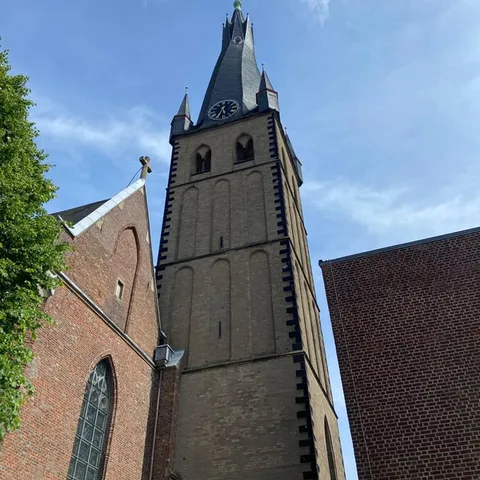
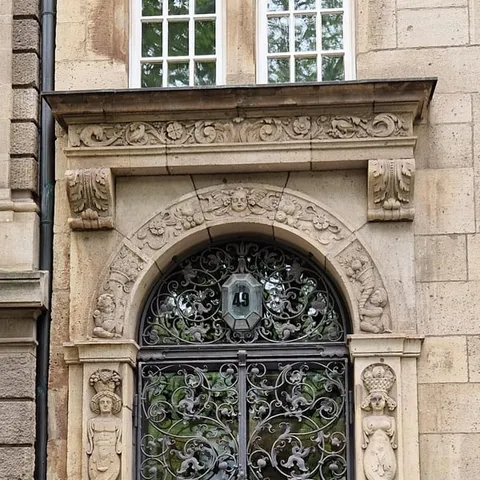
The MedienHafen is home to more than 700 companies and some of the best and most popular restaurants in the city.
Who the harbour is for now
Booking the harbour walk
On the day in the district
- The tour runs for 2 hours with a live guide[5]
- Wear comfortable shoes; the route is on paved paths beside the water
- Trams and trains stop within a short walk of the harbour basin
- Late afternoon light on the water is good for photos of the towers
From Industrial Docks to Media District
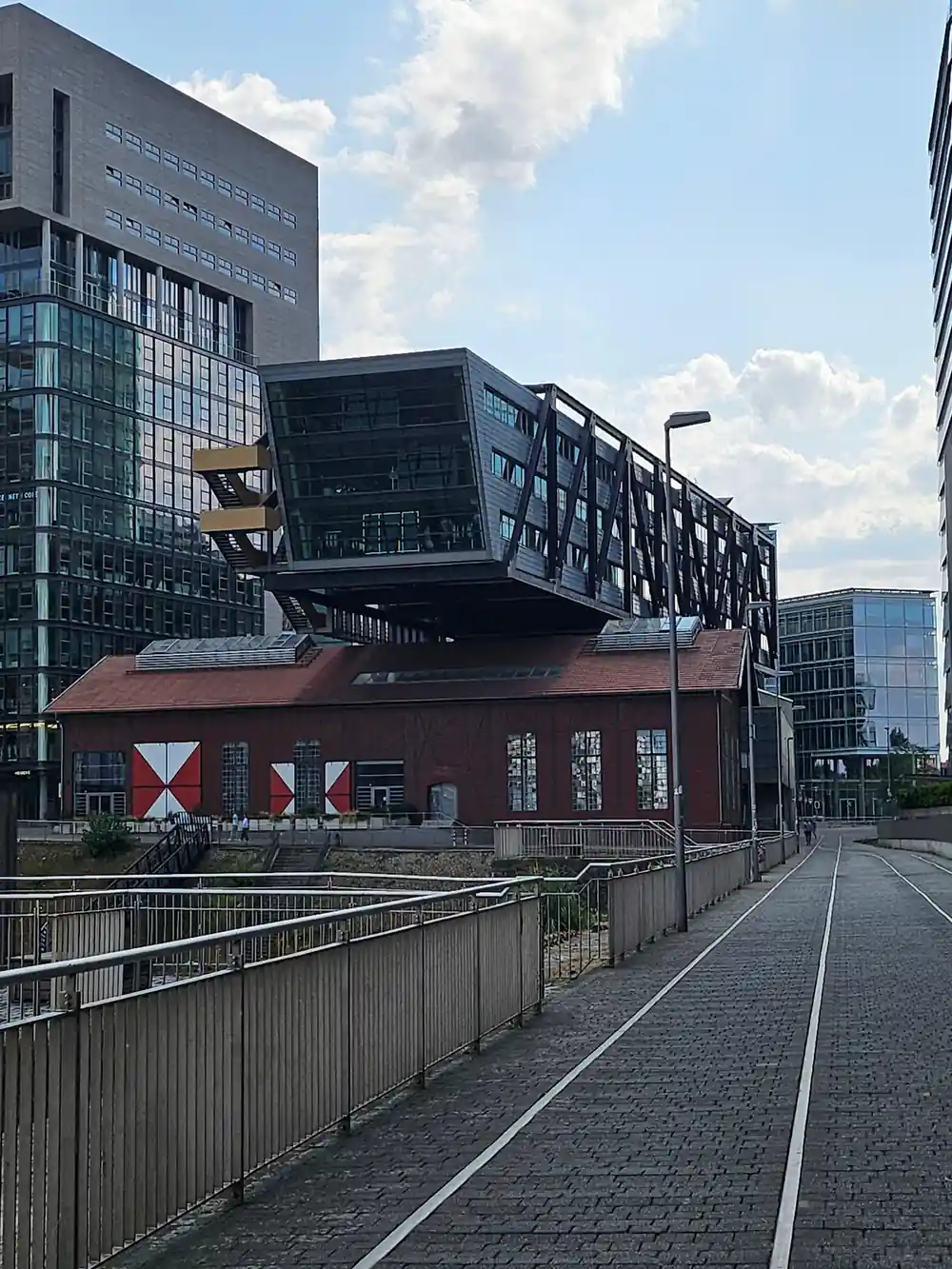
The water in the MedienHafen was a working dock, and the cranes, rails and quay walls still hint at that life. At the end of the 19th century, the docks lay at the southern end of the Rheinuferpromenade and played a part in the city's boom until the end of WWII.[8] Barges tied up where café tables now stand, and warehouses took up almost the whole waterfront, with goods moving in and out by river and rail.
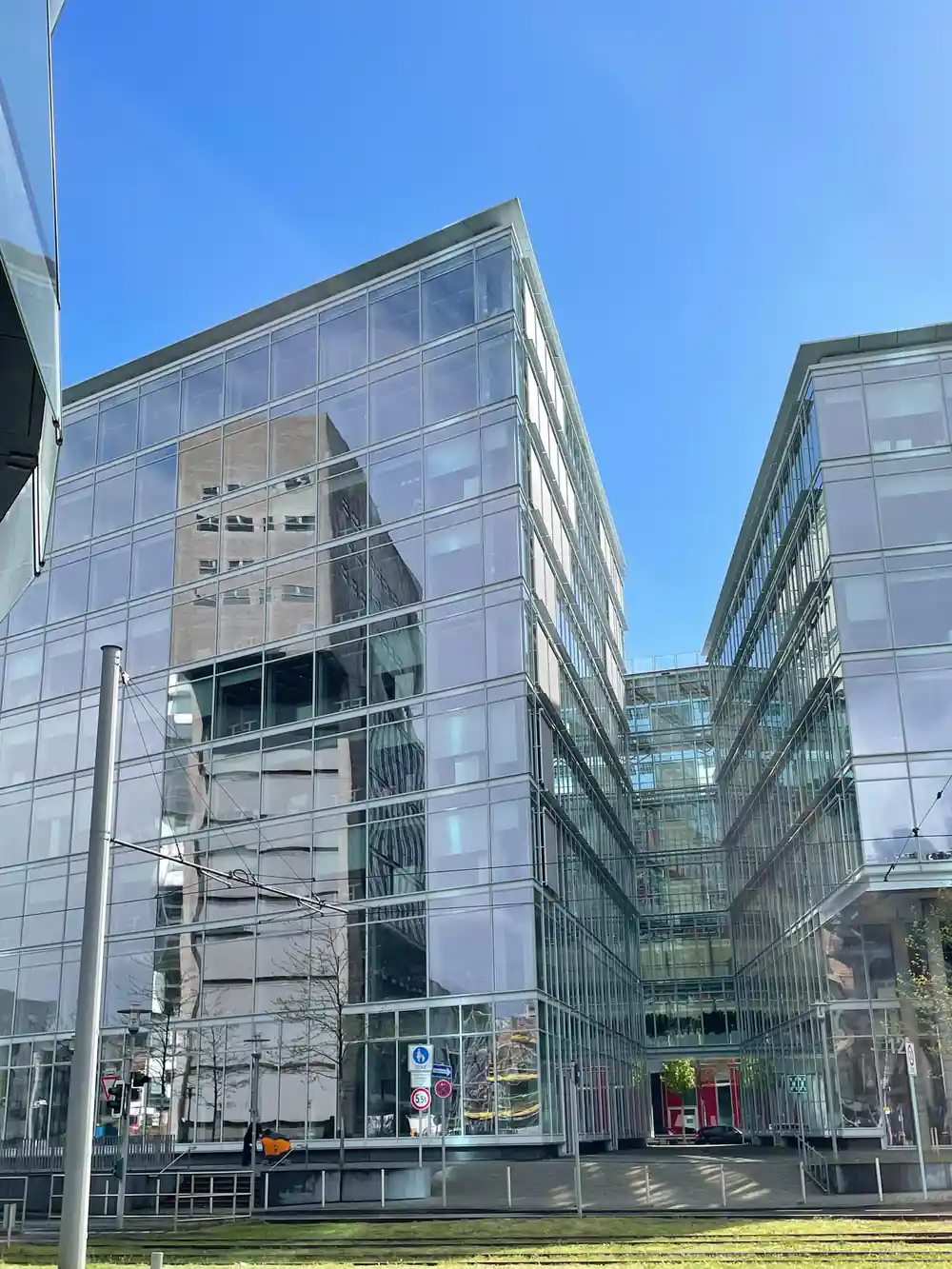
In the 1980s and 1990s, Dusseldorf's city planners and developers recognised an opportunity in the vacant waterfront.[1] The basin was kept, the quays were repaired, and the old sheds were rebuilt from the inside out. Offices, studios and flats moved in behind brick and glass, and the district took a new name, MedienHafen. The result is a harbour that still looks like a harbour but works like a business district.
The river sets the mood. The Rhine is 1320 km long.[9] In 1995, the Rhine crested at 10.69 meters at Dusseldorf, testing the harbor's flood defenses.[10] Today the promenade in front of the harbour is wide and open, a place for lunchtime walks between offices and for watching the boats turn in the basin.
Media Companies and Broadcasting Headquarters
The name says what the district became. The MedienHafen is home to more than 700 companies.[2] They sit in glass towers, in brick warehouses with new insides, and in low buildings along the water. On a weekday you see deliveries at the doors, coffee runs on the quay and people working on laptops at the waterside, which is often the closest thing to a staff canteen.
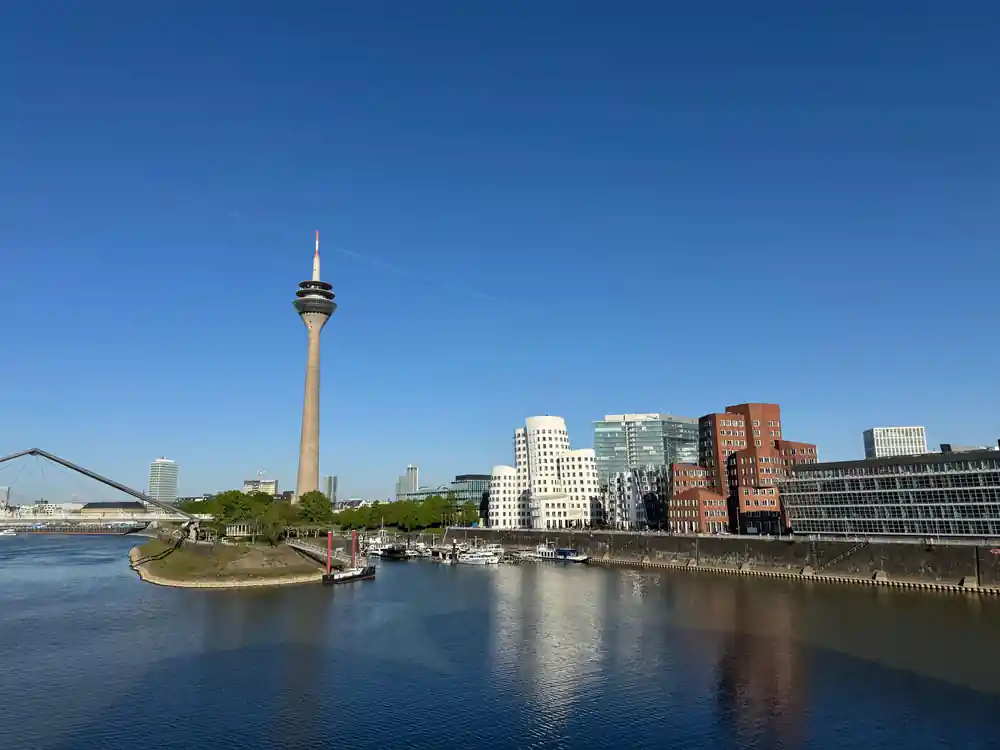
The Rhine Tower is the landmark everyone uses to find the harbour. The Rheinturm is 240.5 metres tall and was built between 1979 and 1982.[11] Its light clock, the Lichtzeitpegel, is an architectural installation by Horst H. Baumann that shows the time with a vertical series of lights.[12] Look up after dark and you can read the hours in light.
Media work here is a mix of the practical and the creative: production offices, agencies, design studios, publishers and the people who keep them running. The scale helps. The district is compact enough to cross on foot, so a meeting on the other side of the water is a short walk rather than a taxi ride, and most teams know their neighbours by sight.
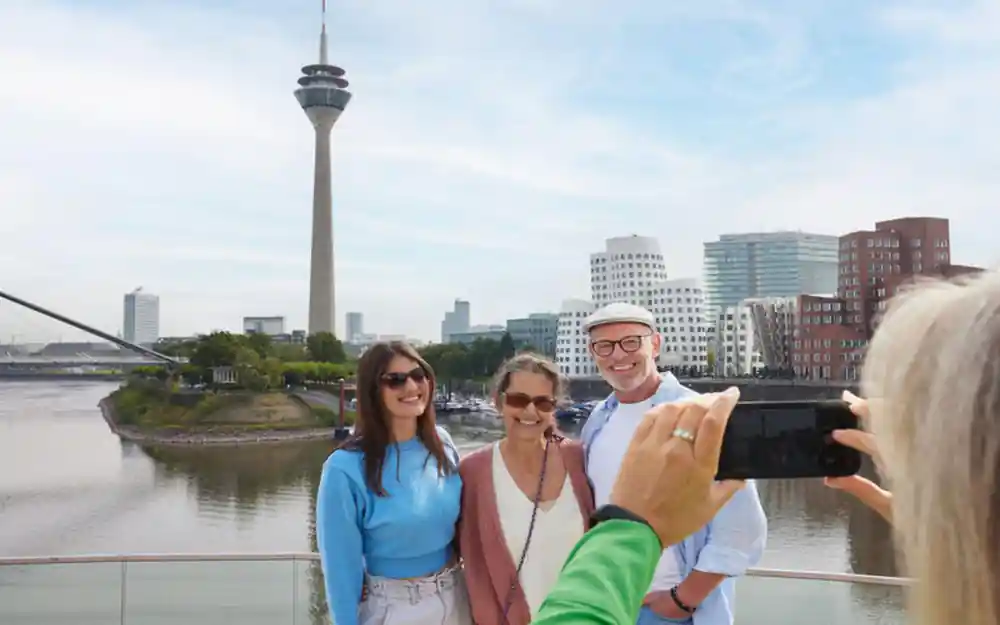
Quayside buildings and the Rhine Tower above the harbour water.
Fashion Showrooms and Advertising Offices
Fashion and advertising offices sit alongside the media businesses. Clothing companies use the district for showrooms and press days, and agencies take the big, open floors with views over the water. It is a working district rather than a shopping one, and the doors are not open to visitors, but the signs, shopfronts and lobbies tell you a good deal about who is inside.
The city has a long fashion and marketing trade. Fashion ID Gmbh & Co. KG is headquartered in Dusseldorf, Germany, according to a RevenueBase list of fashion digital marketing agencies.[4] Work like this needs open floors, good light and room for a photo shoot or a sample rail, and the converted quayside buildings offer plenty of all three.
Between meetings there is the promenade. It is one and a half kilometers long and runs the length of the waterfront, an easy route for a walk between appointments or a loop before the tram home.[13] Bring a light coat in case the wind comes up the river.
What Happened Inside the Converted Warehouses
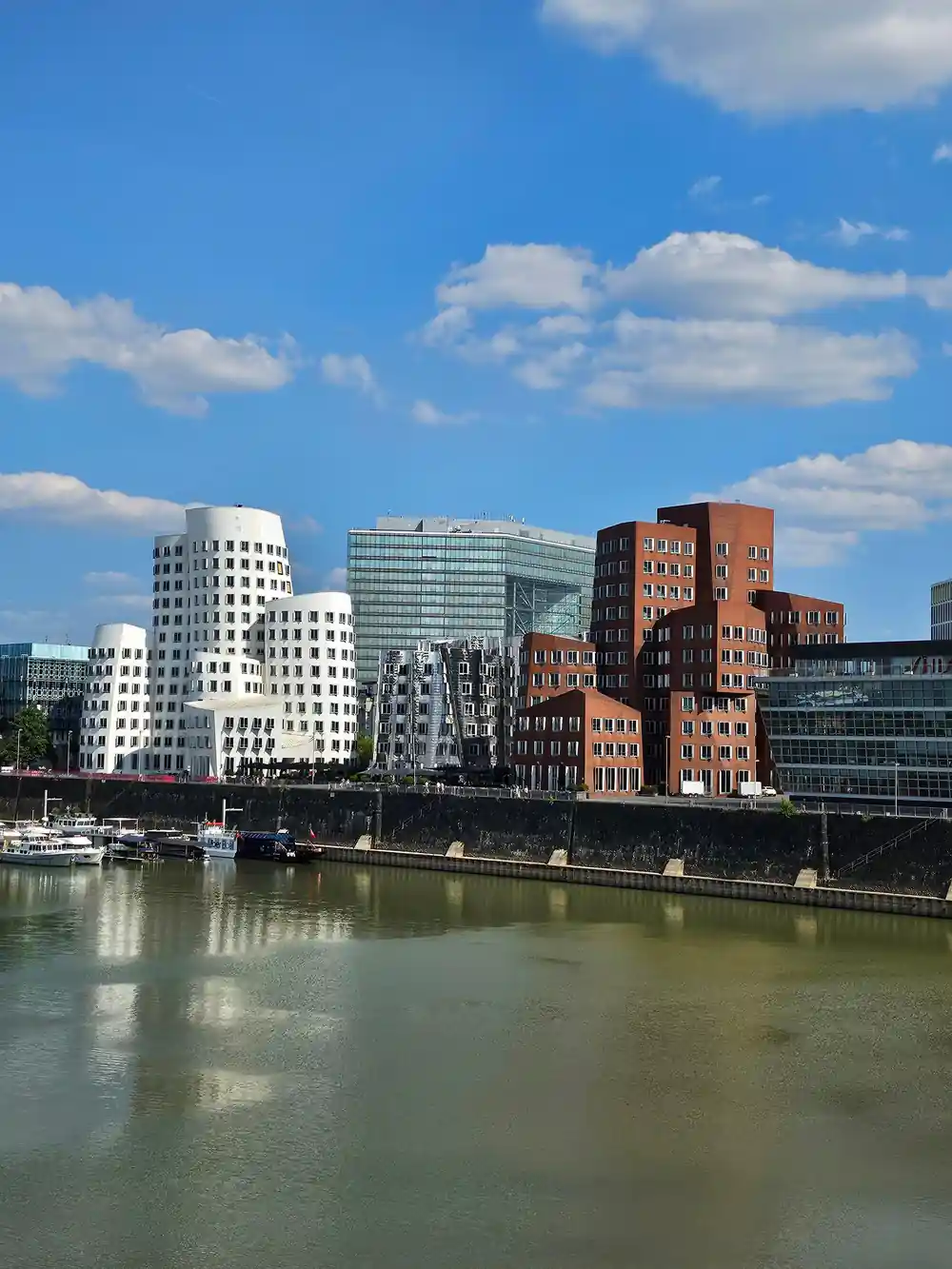
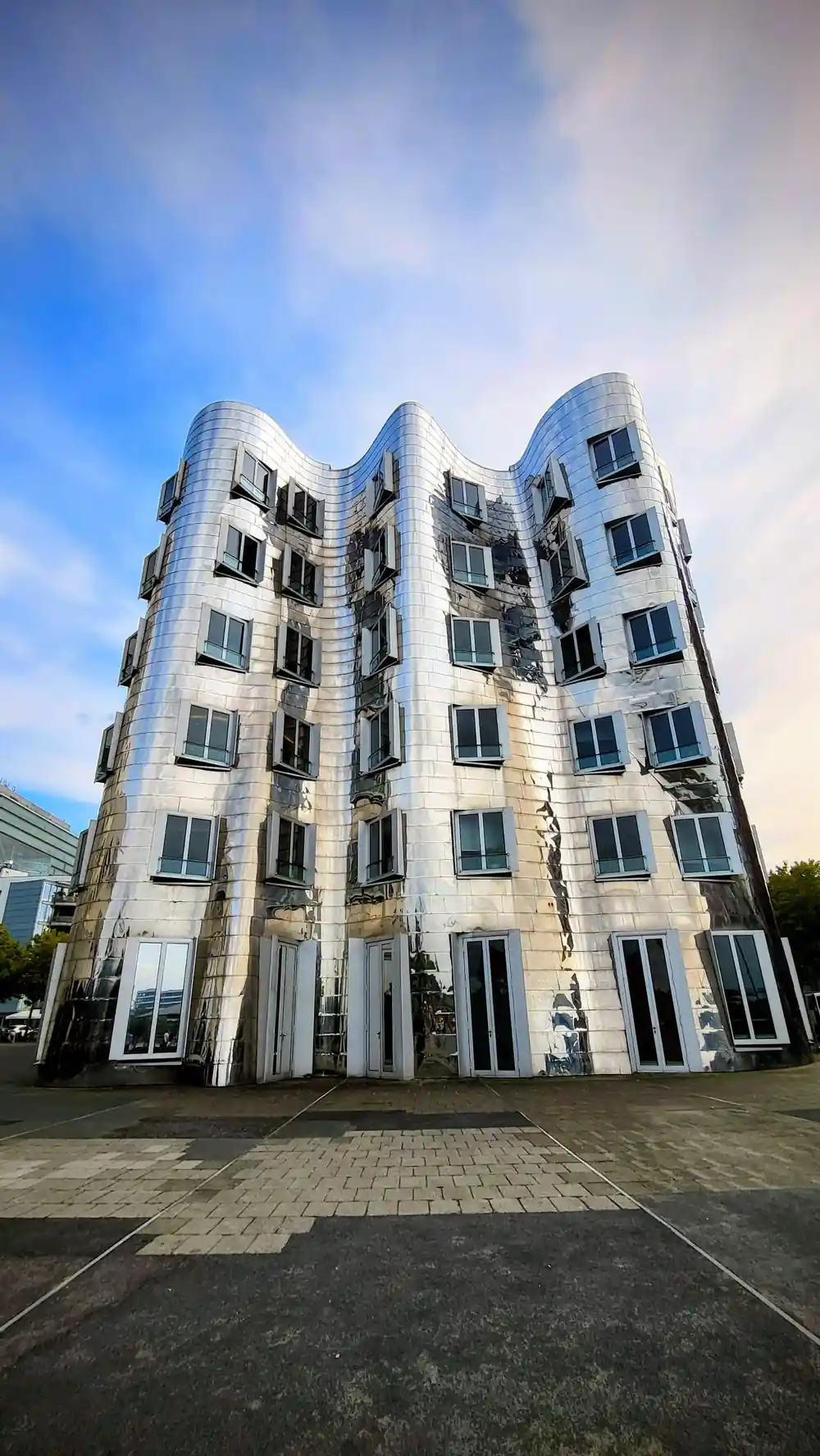
Start with the Neuer Zollhof. It is a complex of three buildings designed by Frank Gehry, completed in 1999, and it stands right at the water's edge.[3] The facades lean, curve and tilt, and the stainless steel, white render and brick catch the light differently through the day, so the same corner looks new each time you pass.
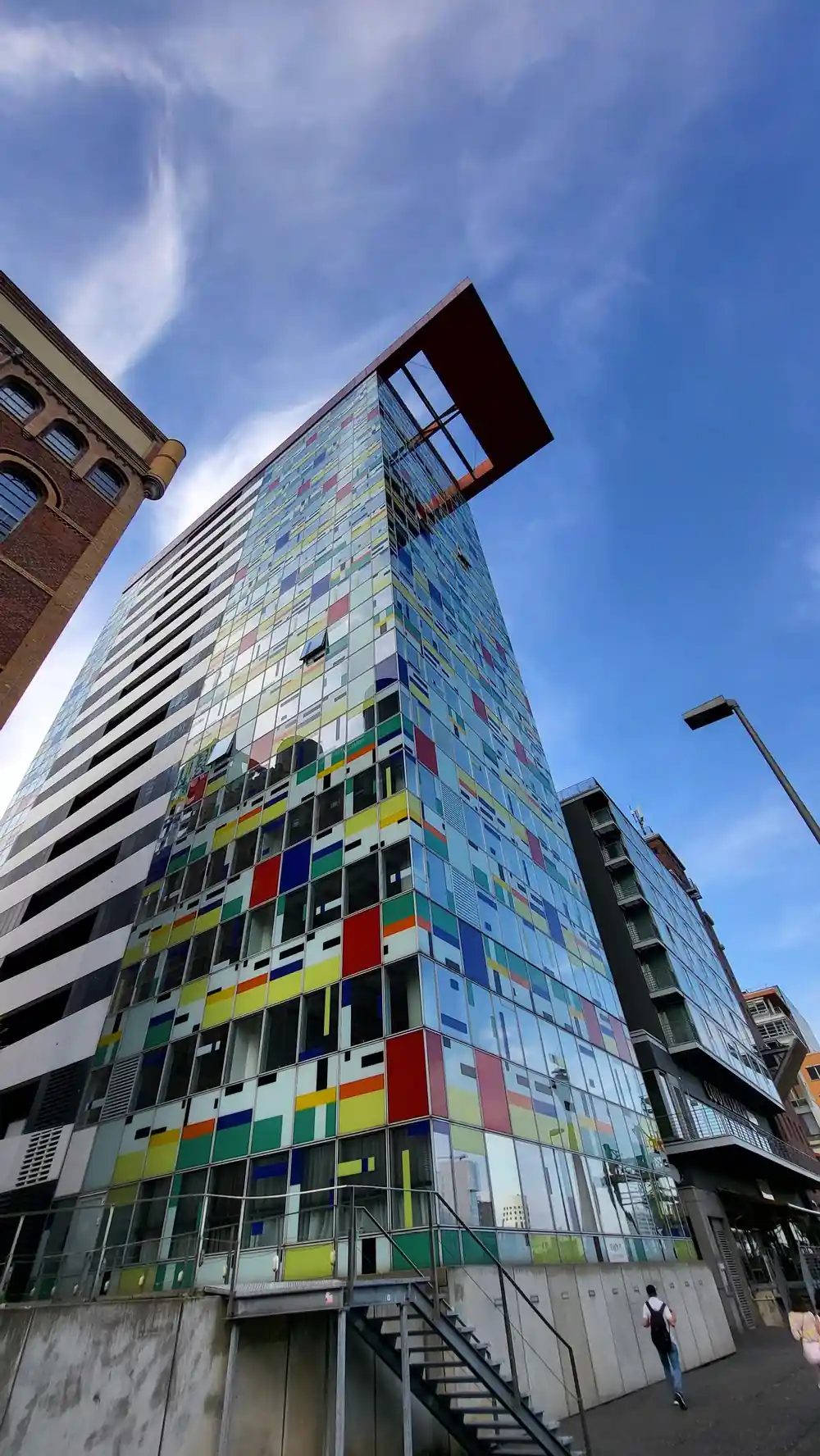
Not everything in the harbour is old. The Colorium Building, designed by British architect Will Alsop, stands 17 stories tall.[14] Together with the converted warehouses it shows both halves of the district's character: the working shell that stayed and the new tower that arrived beside it.
Inside the old sheds, the changes are practical. Double-height floors became offices and flats, loading bays became entrances, and ground floors turned into restaurants, gyms and small studios. Look up as you pass and you will still spot old beams, hooks and rails where the conversion left them in place, a reminder of what the buildings used to do.
Over 700
The MedienHafen is home to more than 700 companies, in converted quayside buildings and new towers beside the Rhine.[2]
Artists, Bars and Evening Life
Creative tenants usually arrive before the crowds. Studios, small galleries and rehearsal rooms take cheap space first, then bars and restaurants follow, and a district starts to stay awake after six. The harbour has that mix now: quiet offices by day, waterside tables in the evening, and a short walk to the older streets when you want more noise.
Evening plans often start with beer. A brewery tour with Alt beer tastings runs for 2 hours and is listed from US$32.[15] The Altbier-Safari beer walking tour is listed from US$42.[16] For a longer night, a pub crawl through the old town covers 4 locations and is listed from US$29.[17]
The MedienHafen party mood is gentler than the Altstadt's. For a MedienHafen Düsseldorf party, expect terraces and river views rather than loud bars. A 1-hour sightseeing cruise on the Rhine is listed from US$23,[18] a calm way to end a working day.
Living in the Harbour: Residential Communities
People live here too. Flats sit above the offices, in the converted warehouses and in newer blocks set back from the water. Residents get the promenade on the doorstep, trams a short walk away, and the old town within easy reach along the embankment. Balconies look straight onto the basin, and the morning walk to work can be a few flights of stairs.
The city draws plenty of visitors. Düsseldorf recorded 3,068,803 guest arrivals in 2018.[19] Trade fair weeks are worth planning around if you want a waterside table, and the harbour's hotels fill with people who have meetings on both sides of the water.
If you are choosing a base, the harbour works well. It is walkable to the Altstadt, close to the Rhine Tower, and connected by tram and train. Ask about noise when you book, since some flats and hotel rooms look straight onto the bars, and ask whether your building has a courtyard side.
A Typical Working Day in the MedienHafen
A harbour working day starts early. Coffee, a short walk along the water, then a desk with a view of cranes and masts. The district is small enough to cross on foot between meetings, and the promenade gives everyone somewhere to think, take a call or eat a sandwich in the sun.
Lunch is the busiest hour. Restaurants between the offices fill up, and the benches along the quay fill faster still when the sun is out. In the afternoon the light moves across the Gehry facades and the Rhine Tower, and photographers start arriving with tripods and phones.
If you want to understand the place rather than pass through it, take a guided walk. The MedienHafen tour runs for 2 hours with a live guide in German and English and is listed from US$218.[5] A private group option is available, and free cancellation is offered up to 24 hours in advance for a full refund.[5] You can reserve now and pay later, and check availability to see the starting times.[5]
Beer and evening tours: listed from-prices
Harbour and old town walks: from-prices
US dollar from-prices of GetYourGuide listings:[5][6][7][22]
When to plan a harbour visit
Planning your harbour visit
Book the walk
Reserve the MedienHafen tour and check the listed start times before you fix the rest of your day.[5]
Check the language
The live guide works in German and English, so choose the slot that suits your group.[5]
Dress for the water
The route is outdoors on paved paths, and the tour lasts 2 hours, so take a light jacket.[5]
Add a beer stop
A brewery tour with Alt beer tastings lasts 2 hours and is listed from US$32, a short walk from the harbour.[15]
Stay for the evening
The Night Watchman tour, from US$24 for 1.5 hours, carries the evening on through the old town.[23]
See the MedienHafen with a local guide
from US$219Reserve now & pay later